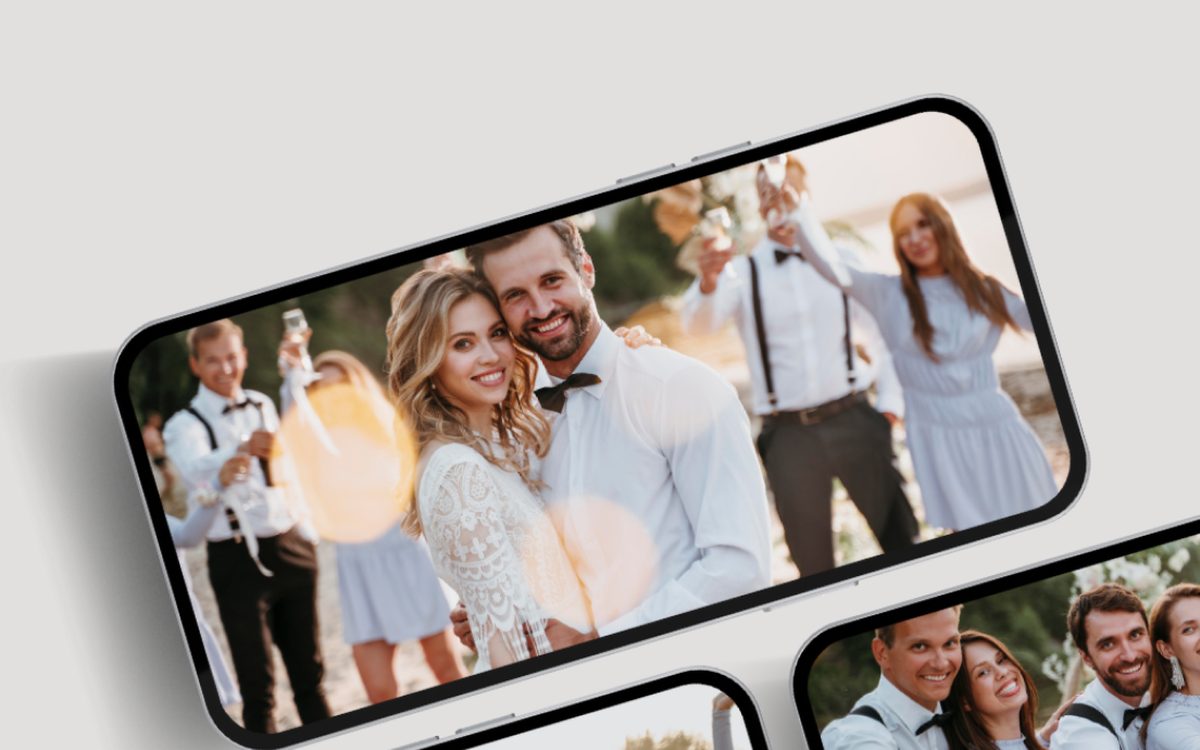
Your photographer will do beautiful work. But they are one person, with one lens, standing in one spot. Meanwhile, eighty of your guests are holding phones and capturing exactly the moments a professional physically cannot reach — your grandmother reacting at table three, the best man attempting to dance, the children playing outside the venue.
The problem is not that guests do not take photos. The problem is that those photos never reach you. After the wedding everyone returns to their life, and hundreds of images stay scattered across dozens of camera rolls.
Why guest photos usually disappear
It is not a lack of goodwill. People genuinely mean to send you the pictures. But between that intention and your gallery sit a few obstacles almost nobody clears.
- Sending takes effort. Picking fifty photos out of a camera roll of a thousand, then waiting for the upload, is twenty minutes of work nobody plans for.
- Messaging apps destroy quality. Photos sent through chat are usually compressed, so you end up with a version you cannot print properly.
- Nobody knows where to send them. If you never said clearly where the photos go, every guest assumes somebody else already handled it.
- The moment passes. A week after the wedding the enthusiasm fades, and a month later nobody remembers the promise.
Five ways to collect photos, and where each one breaks
Before we get to the approach we recommend, it is worth walking honestly through the usual options. Each has its place, and each has a cost.
A shared group chat is the fastest thing to set up and everyone already knows how to use it. The downsides are compression, chaotic ordering, and the fact that two weeks later the group has become a place for everything except wedding photos.
A shared cloud album preserves full quality, but it requires every guest to have an account with the same provider and to know how to join an album. On a wedding day that is too many steps.
Disposable cameras on the tables are charming and guests enjoy them. Developing costs add up quickly, though, and out of thirty-six frames roughly ten tend to be usable.
Asking guests to email you photos sounds tidy, but in practice you receive five emails with three photos each — and nothing from the guests who shot the most.
A shared gallery behind a QR code solves all of the above at once, and that is what the rest of this article is about.
A shared gallery: one code, one PIN, every photo
The idea is simple. Instead of chasing every guest for photos after the wedding, everyone drops them in the same place during the evening.
Flyers with a QR code sit on the tables. A guest scans it, downloads the app and enters your wedding PIN. No registration, no account, no extra steps. From scanning to the first photo takes about thirty seconds.
Everything the guest shoots from then on goes straight into your shared gallery, at full quality. Along the way guests also see each other photos, which nudges them to keep shooting — and that is the difference between fifty and five hundred photos by the end of the night.
What you get after the wedding
Your gallery is ready 48 hours after the wedding. It stays open to guests for another 24 hours after the celebration, so they can still add photos taken on their own camera or earlier in the day.
You download everything at once with a single click, or pick individual favorites. The photos are yours forever, with no time limit and no subscription.
What to do the week before
- Print enough flyers. The rule is simple: at least one per table, plus a few at the bar and by the entrance.
- Ask whoever is hosting to mention the gallery. One sentence before the starters is worth more than ten flyers.
- Put a flyer where people linger — by the dessert table or outside the venue, where most photos get taken anyway.
- Check the signal in the room. If reception is weak, arrange wifi access with the venue and print the password on the flyer.